Thursday, November 7, 2019

A Visit to the National Library of Kosovo


On October 5th 2019, I was lucky enough to travel from Portland, Oregon to Pristina, Kosovo to serve for three weeks as a Fulbright Specialist at the National Library of Kosovo.  I knew very little about Kosovo before this opportunity. I think the name Kosovo was familiar to me from the 90s when the United States intervened there under the Clinton administration. Of course, I jumped at the chance to visit the Balkans for the first time ever. I was not disappointed.

The National Library is located in Pristina, the capital of Kosovo, which is a very hip, thriving city with a mishmash of architecture. The National Library itself is a stunning example of brutalist design that takes some of its cues from the historic mosques and cathedrals of Kosovo. It's one of the most well know structures in Pristina.

The National Library at night

I was tasked with facilitating the development of a five year strategic plan for the National Library. This was a bit of a daunting task from the start as the library essentially operates in Albanian and most of its annual reports and operating documentation are in Albanian (though English is mandated as one of the official languages for government laws and regulations).

I kicked off my first day by meeting with the Governing Council of the National Library, made up largely of scholars and the head of another government ministry. After espressos and sparkling water delivered to our meeting space by the in-house library cafe, we enjoyed lunch at Symphony, traditional Kosovar Albanian and a favorite of the library leadership. I had one of their specialities: steak cooked on a hot rock delivered to your place setting.

Yugoslav-era clock in the staff lounge.
The next day I got a tour of the building. Its truly an architectural marvel, with stunning modernist design details everywhere from the grand entryway and atrium to the elevators and stairways. I took tons of pictures, but then I discovered that the Getty Foundation had recently done a conservation study on the building which does an impressive job of documenting its design. There are 99 domes in the library and most rooms are built under a dome of a particular size.

The closed stacks

On my tour I learned that the core service provided by the library is housing and providing access to a closed stacks collection. The building's bottom two floors are outfitted as closed stacks (complete with a Yugoslav-era mechanical book escalator) and materials are housed there by accession number. The library's main function is to accession, catalog, store, and retrieve materials from this repository. As it serves as The Library of Congress for Kosovo, the Library automatically receives a copy of any book published in Kosovo and must also issue ISBNs to publishers. As it is the library of record it also does pretty much all original cataloging.

One of the reading rooms.
The strategic planning workshop sessions started soon after the tours. In these sessions I met with various library units and tried to suss out the library's needs, interests, aspirations, etc. On some of them we used the standard Strengths Weaknesses Opportunities and Threats framework. The discussions happened mostly through a translator, which slowed the pace a bit, but generally worked well. Flip charts were deployed but we managed to avoid colored dots. 

Sometimes it took discussing around a topic to finally reveal a big, important piece of information that I probably should have known from the beginning. Like the relationship of the University Library to the National Library (which I still can't exactly explain) or the fact the library was about to deploy a new organziational structure.

Workshopping the strategic plan.
The library has about 80 staff members and I probably met with 30+. All of them were very dedicated to their jobs and quite enthusiastic about the mission of the library. The range of positions I encountered included someone who did bookbinding and restoration, to the repository manager, to circulation attendants, the head of acquisitions and the associate director.

The October afternoons were warm and sunny and some of the rooms in the library got quite hot with the sunlight beating down on the domes. Mostly I spent my late afternoons hanging out at cafes and working. I knocked down two to three of machiato's a day (Pristina's favorite coffee drink). In the first week and a half or so I poured over documentation about the library with the aid of Google Translate and did an "environmental scan" of other national libraries to see how Kosovo's activities compared. The last week and a half I spent drafting the strategic plan.

Starting the day off right at Prince Coffee Shop at the Grand Hotel Pristina.
Some themes emerged which came out in the plan. The building is a major asset, it's location being right at the center of the University of Pristina and of Pristina itself. It's distinct architecture makes it a Pristina landmark, a place for hosting various government and nongovernmental events and exhibits, and even a tourist destination. The building was neglected for many years, especially during the 1990s and only in the last two decades has there been regular updates and maintenance. A big part of the plan is to continue improving the building with the aid of a master plan, which can help align the building's space usage with the library's programmatic needs.

Even though the University of Pristina provides some library resources, the National Library acts as a defacto library for their students. I met with a group of students who were quite interested in improving the library's spaces and expanding services. Despite a somewhat cumbersome system (at least by US standards) of calling books from the closed stacks and then only using them in the designated reading rooms, these students were frequent and enthusiastic users of the library. Among library staff there was clear interest in moving to at least a partial open stacks configuration as well as a more comprehensive reference/research services setup, so this is part of the draft plan as well.

The National Library rotunda.
The library's position as the "highest library" in Kosovo led me to look into best practices at national libraries, particularly those of small countries. I found that many of them had advanced services for digital book delivery, e book deposit, and web site harvesting. The National Library of Kosovo is on the cusp of launching a digital library of cultural heritage material and this should be its first step in building out a set of digital operations. The library currently does all its cataloging work in isolation on an aging Aleph system they share with a couple of the larger public library systems in Kosovo. On the agenda is consideration of OCLC membership, which would help them take advatange of existing bibliographic records and share their own records, as well as build out a library network in Kosovo. Interestingly, there is a major library consortium called COBISS in the Balkans that has its own home-grown integrated library system that grew out of a system from the Yugoslav days.


Kosovo is an area that has had a difficult history both in the recent past and further back. Almost everyone I spoke with had a story of exile during the war in the late 90s and many people never returned. Capturing the recent history of Kosovo that is still within living memory is a major opportunity for the National Library. The nineties are a particularly interesting period as Yugoslav-Serb repression led the Albanian community in Kosovo to develop parallel governmental and educational institutions. I learned of an idea for an exciting project to recover some of that history through interviews and various forms of documentation. 

The Kosovo flag has six stars to represent the major ethnic groups of Kosovo: Albanians, Serbs, Turks, Gorani, Romani, and Bosniaks. Though the Kosovar Albanians dominate at 95% of the population, the National Library is charged with representing all the ethnic minorities in the state, and this task is also an aspect of the plan. 

The Kosovo Flag, courtesy of Wikimedia

With Kosovo being a new state that was formed out of an international intervention, there is a large international presence in Pristina.  There are many NGOs, consuls and embassys and it seems like half the people you meet work for one of these things. The United States State Department still has a very large presence in the country with a large new Embassy. Even in the library there is an "American Corner" which offers English language library resources to check-out as well as programming designed to engage young people. Living in the US it's hard to comprehend the influence this country wields abroad.

Bill Clinton statue on Bulevardi Bill Klinton in Pristina

The strategic plan that I drafted will now go through a process of further review and modification and hopefully reach a final stage in the next few months.  

Fueling the strategic plan with a 'big macchiato'


Wednesday, July 30, 2014

managing e resources in a modern ILS: shared work or vendor provided service?

The Orbis Cascade Alliance Summer Meeting happened a few weeks back in downtown Portland. It's an exciting time for the Alliance as we enter the home stretch towards the migration to a shared integrated library system. The feeling is very much a different one than previous Alliance meetings--there is a much deeper sense that we are working together.

One of the most exciting things about the Alliance's SILS project is the possibility sharing tasks across Alliance institutions. For example, the Alliance now loads the records for the electronic books in it's demand driven program centrally whereas previously the task was repeated locally at all 37 Alliance libraries.

The Network Zone where Alliance members share bibilographic records set now has the capability to manage shared sets of bibliographic records for the entire consortium or even subsets of the consortium. The SILS environment holds great promise in shared cataloging, acquisitions, collection management and discovery.

But even as we see the possibility of more efficient workflows in the integrated library system, there's a case to be made that as resources go more digital, the work traditionally done in the ILS should shift away from to vendors or other network-level providers.

In some ways, I want our ILS to act as a seamless layer between content providers and patrons. When my library decides to subscribe to an e book package or  a new journal, I want it to be as easy as purchasing a Kindle book on Amazon. We select the resource, pay for it, and it magically becomes findable to our patrons. Acquiring and loading files of MARC records and then updating them periodically should be a thing of the past, tasks absorbed by the ILS vendor or some other network-level intermediary,

We're getting close to this reality. Activating a package of e-books can be as easy as clicking a box in our new system. But often enough, there is still much local work that needs to be done in terms of purchasing and loading records to make things findable.

As vendor-level services for e resources get stronger, I wonder what role the collective technical services workforce of the Alliance can play in the electronic resources ecosystem? Discoverability of e-content is about more than MARC records these days and often involves vendors giving discovery providers and search engines access to the full text of content.

I'm guessing that even as the mainstream processes for making e resources discoverable get less labor intensive for libraries, there will always be exceptions and special cases where institutional and consortial expertise are needed to make things discoverable.  Libraries will need to work together to create and load metadata for that obscure set of video recordings or ebooks.

The Alliance is now in a position to be a powerful player in this space and really define ways that libraries can add value in the area of electronic resource discoverability. For a single library cataloging an entire set of e books seems out-of-reach, but a consortium, if well organized could do so with its collective workforce.

I'm looking forward to seeing how things shake out.


Tuesday, July 30, 2013

Digital Initiatives, Scalability and Sustainability

As part of my work as a NITLE fellow, I'm considering the role of digital collections programs at liberal arts college libraries.  A little over two years ago, I posted about our digital initiatives program at Lewis & Clark, reflecting on its approach to projects and services.

One of my contentions in that post was that the project-based approach to supporting digital collections was particularly compelling as it tapped into passion for a particular topic.  Indeed, looking at the work of the Five Colleges of Ohio stemming from their  Next Generation Library: Integrating Digital Collections into the Liberal Arts Curriculum grant project, it appears that approach is alive and well at liberal arts college libraries.  Their focus has been mini-grants to support the development of digital collections with direct potential for integration in the curriculum.  From the history of fashion, to interviews with farmers, to visualizing proteins in plants, this impressive set of collections all reflect active teaching, research or creative activities at the Five Colleges.

Over the last two years, Watzek Digital Initatives has maintained the project-based approach, a recent example of which is L. Stanley Glarum Collection.  But we have also began to support more programmatic endeavors, one example of which is our Lewis & Clark Around the World platform, which supports documentation of overseas study.   Each semester two or more overseas programs employ the platform to engage in learning activities on their programs.  The Digital Field Scholarship sandbox project, conducted this academic year involved support and configuration of the WordPress platform for a number of field based projects at Lewis & Clark and our NITLE partners.  Creating platforms and programs that can serve multiple classes and projects is a way to gain some efficiency and scale in a small digital initiatives program.

I noticed that the Journal of Library Administration's most recent issue focuses on support for digital scholarship in libraries, research libraries in particular.  I found the Vinopal/McCormick piece on scalability and sustainability particularly interesting, especially their pyramid of digital scholarship services.  


The goal is to move successful practices down the pyramid, to make them "scaleable and repeatable," a reference I borrow from Lorcan Dempsey's latest blog post.  

Customizing Omeka it for a particular collection, such as the Glarum archive mentioned above, is becoming one of our standardized services.


Monday, July 30, 2012

Amherst to Annapolis

I want to compliment Bryn Geffert for a very lucid and provocative presentation to the Annapolis Group on scholarly publishing. I'd heard about this from my Dean, and when I started watching it I kind of expected the same old story of rising and unsustainable journals prices. He definitely covers that ground, but then takes it a step further and analyzes ways in which the other parts of the publishing ecosystem, particularly scholarly monographs, have suffered because of the cost pressures in the serials area.

One of his suggestions revolves around collaborating between libraries to establish standards about which publications are overpriced and working together to boycott them. I think this makes a lot of sense but I wonder if cooperating in this way would be legally problematic at all. In any case, using libraries' economic power as buyers to say no when the price is too high is what we need to do.

The boldest part of the talk proposes that libraries use their acquisitions budgets, and even some of their staff lines in the case of Amherst, to fund open access publishing ventures. It's a simple equation really: take money from libraries that is going to pay publishers for books that are often of poor quality and use it to support high quality publishing ventures whose products are open to the world. 

If we extrapolate this proposal into a grand vision of a new scholarly communication ecosystem (and I'm not sure Geffert intends this), universities and colleges would subsidize a wide variety of high quality presses that would all produce open access work. The money would y come from library acquisitions budgets.  I think this is a good approach that will work in some cases, but it won't be the entire new reality  It's sort of like pointing to wind or solar power as the energy of the future. They are an important, increasing in relevance and have many advantages, but they will be part of a larger mixture in the future. In scholarly communication, I think we will have lots of publishing models coexisting for awhile.

At a well-endowed school like Amherst, it's easy to see a library budget as a relatively fixed resource to be deployed in various ways. Given the widespread cost pressures on colleges and universities, a press funded through what used to be library acquisitions budget might be financially sustainable if it ties in strongly to the mission of its parent institution. But 10 years down the road when the next economic crisis hits, will it?

I'm more optimistic about a bigger shift in thinking that may take place if scholars and institutions begin to see the review and dissemination of research as part of the research costs.  Not sure how we'll get there but legislation that mandates open access to federally funded research is a good step.

For a contrast to his talk, have a look at this piece in Scholarly Kitchen, which reviews the Robert Levine book Free Ride.  While I am sympathetic with the notion that the current system could better compensate creatives, the demonizing of Creative Commons and open access journals is ridiculous.

Thursday, March 8, 2012

Raising Expectations: The Strategic Potential of the Academic Library in Liberal Education

The following are slides and a transcript of a job talk that I gave at Lewis & Clark on March 15th, 2012.


Introduction


The role of the liberal arts college library in the 21st century remains an open question. Much of the library literature on the future of academic libraries pertains to research libraries or academic libraries generally. The liberal arts college library is a special genre of academic library that holds great potential in the digital era and leaves a considerable amount of room for self-definition.


I believe that the liberal arts library has the potential to advance learning and scholarship in ways that distinguish its institution. Going forward, we will provide an evolving suite of resources and services that incorporates local collections, consortial cooperation, and networked technologies. Through partnerships with faculty and close relationships with students, librarians will raise expectations about what is possible in student research and creativity. The library will provide faculty the resources, platforms and support needed to to pursue innovative projects and offer students opportunities to make their own discoveries as they explore resources in traditional and emerging forms of media.


Before exploring this vision in more detail, I think it is worthwhile to review some of the broader twenty-first century context in which academic libraries at liberal arts colleges operate.


Clearly digital technologies have changed our relationship with information in ways that we are still trying to comprehend. Retrieval of information through search engines has accustomed a new generation to instant gratification in information seeking, though arguably only at a rather shallow level. New forms of media consumption including digital music, video, blogs, online reading and gaming have altered our experiences with media. With an abundance of information, we’ve shifted from a scarcity of content to a scarcity of context. A fundamental aspect of work our in higher education, and the liberal arts particularly, is to provide the latter.


The opportunity to interact with online content using various social media has opened the door for participatory knowledge creation unlimited by the boundaries of time and space. In many cutting edge fields from medicine to information technology to art, in order to innovate, it’s not enough to have access to authoritative works in the field. Rather one needs to be in the flow of knowledge that top players in that field are continually exchanging in real time through social media as well as interpersonal interactions.


On an economic level, the Internet has allowed many industries to move activities done locally to larger levels of scale, and believe me this is affecting libraries in a big way. The latest technology trend I keep hearing about this year is “big data,” which refers to massive amounts of data that are now being collected, stored and analyzed in a variety of industries including retail, energy and academic research.


Within the higher education field, things are hardly stable either. Increasing costs particularly in non-teaching expenditures (do libraries fall into this?) have come up against hard economic realities of strained households unable to pickup tuition increases. The selective, residential liberal arts college model remains strong, but managing costs remains a challenge especially with the demographic flattening of the freshman population in coming years.


A public discussion has bubbled up in the last few years around a “crisis in the humanities” prompted by declining majors in fields like foreign languages and literature. I feel that libraries have a ‘special relationship’ with the humanities disciplines and insofar there is any crisis here, I regard it as our challenge and opportunity.


Here at Lewis & Clark, we are moving boldly forward on a strategic planning initiative that emphasizes academic excellence in a number of key areas: international education, environmental studies, and student-faculty collaboration. The College is exploring liberal arts more broadly in our 21st century context and its potential to position students for a variety of post-baccaluareate opportunities. Meanwhile, it remains vitally important to foster our sense of community as we strive to create a welcoming environment for an increasingly diverse student body. I’m told that at this time of year we are all admissions officers, and this goes for librarians as well.


Information Provider


Now I’m going to move into discussion of various library roles and how I believe that they are evolving in the context of these broader trends. I’m going to regularly drift between generalities about libraries and specifics about what we are doing and where we are going at Lewis & Clark.


The most fundamental role of the library remains an archive and provider of information resources. But if we look at the basic economic model that underpins that role, things get problematic in the digital era pretty quickly. Libraries make sense economically because they are a way to share physical information resources within a geographically bound area-a single library makes more sense than every student and faculty member having a separate library of books at their desk. However, when digital libraries like JSTOR can be built centrally and shared with with any subscriber in the world, the necessity of the library’s information provider role comes into question. As things go digital, we become more of the conduit for content rather than the manager of content ourselves.


Physical books remain the proven form of scholarly communication for many fields and we continue to spend 90% of our book budget on them. Before getting into digital formats lets look at how that plays out. One way that we collect books centers around building strong general collections where students can browse and discover information in their field. With bookstores closely we’re getting to be one of the last places to browse physical books, and my belief is that we’ll continue to build collections like this in certain humanities fields where the preference is for the physical book. We’re also now building our collection with the Summit collection in mind; as we buy books we look carefully to see if its held in Summit before deciding to purchase it locally.


Another way that we buy books is by working very closely with faculty to support particular courses. For example, we collaborated with Art Historian Ben David to create a set of books, articles and digital images to support his course, “Dante and the Visual Arts: last spring. Ben worked with Visual Resources Coordinator Stephanie Beene, Collection Development Librarian Jim Bunnelle, and Stafford Archivist Paul Merchant to assemble the readings, many of which were rare and hard to acquire. My colleagues in Access Services Rick Peterson and David Shratter worked with Ben to set up a mini reading room adjacent to the art books and the Visual Resources Center so that students could access and read the texts in a social sort of way.


Our librarians foster this model of collaborative collection development frequently in topical literary courses from Chaucer to Virginia Woolf to, most recently, the Charles Dickens course taught by Pauls Toutonghi this spring, which incorporated an exhibit as well as research assignments that directed students to engage our Dickens collection. I find this strategy for collection development partcularly exciting and effective because it is so tightly coupled with the curriculum and offers our students opportunities to encounter sources that often animate their interest in the field.


In both journals and books, the presence of digital formats is growing. A general trend is to subscribe to larger and large aggregations of content whether it be bundles of journals, e books, or research databases. Paying for access to these larger chunks of information saves libraries time and resources because effectively the collections are managed elsewhere. Though I should caution that there is a loss of control and certain vulnerability that comes with outside players owning the content.


New electronic formats do offer us challenges to manage, however. This year we delved into the world of e books in a significant way for the first time using a multifaceted strategy. We leased a large set of e books through E-brary that provides us with some 70,000 titles for a modest annual fee, akin to the Netflix on-demand of e books. We have also participated in two pilot projects for demand driven e books, one through the Orbis Cascade Alliance and another on our own. This purchasing model allow us to put many books out there in our library catalog and only buy ones that students chose to use; it also retains a model where we own the content rather than the vendor.


These e book projects have taken an enormous amount of staff ingenuity on the part of our Collection Development Librarian Jim Bunnelle, who has helped lead the project at the Alliance level, as well as our metadata and technical experts Laura Ayling and Anneliese Dehner. In this increasingly digital world we will still need that local ingenuity in acquisitions and cataloging to handle emerging formats of materials as well as maintain access to older materials. The next phase of the process is evaluation of the e book format.


Before moving on, I might mention a few thoughts about print vs. digital media. I would strongly emphasize that ever different type of media has its own substantive qualities. Some would even go as far as to say “the medium is the message,” as Marshall McCluhan did in the sixties. Books are great as an immersive experience and if you are studying aspects of print culture as we often do in humanities. Electronic media are wonderful when you want interactivity and dialogue around a text.


One commentator in the library field, Scott Walter, recently identified what he termed the service turn: that is, academic libraries will now distinguish themselves increasingly with the services that they provide. Collections remain important, but because so much content is on the network, services will be where the action is, according to Walter. I think liberal arts college libraries have always been oriented this way as we have never had the mandate to build research collections.


As an information provider, liberal arts libraries should provide a set of services that help students access the growing array of information resources out there and assist faculty with the integration of those resources into their courses. These services will take the form of customized search engines (discovery interfaces to us library folk), assistance with preparing course readings, support for copyright compliance, services to support the use of audiovisual material within the curriculum, and integrating new media formats like e books into teaching.


Educator


Recent studies on the information seeking behavior of young people reveal that college students continue to have difficulties navigating the scholarly information environment. Reports from recent studies out of the University of Washington Project Information Literacy and the Ethnographic Research in Illinois Academic Libraries (ERIAL) project break the myth that digital natives have built in mastery of digital information environments. Today’s students are comfortable on the web but have problems with many stages of the academic research process including formulating a topic, selecting a research database and executing searches.


Undergraduate information research from introductory to advanced levels is a central to the kind of liberal education we provide at Lewis & Clark. Learning good research techniques works best as students are pursuing a well structured research assignment on a topic that they are passionate about. In other words the research question is at the forefront of the learning process, not the skills acquisition. Librarians can most effectively facilitate good student research when they work closely with faculty on assignment design, provide in-class library instruction and work with students one-on-one through librarian research consultations.


In recent years, Watzek Library has had success creating a strong library presence in Lewis & Clark’s first year seminar program, Exploration & Discovery. Our research librarians now work closely with over half of all second semester sections on their research projects, in most cases providing in class instruction for students. Last spring, we founded the James J. Kopp First Year Research Award, a great a chance for an underclassman to land an academic award early in their careers. This fall, we sponsored a faculty seminar on research assignment design attended by over a dozen faculty. This spring we have brought more Watzek Librarians into the E&D instruction process, and through Instruction Services Librarian Kate Rubick’s leadership, we have worked to integrate assessment into the instruction process. The inclusion of more librarians in the course delivery has been a wonderfully collaborative endeavor in which has brought the creativity of multiple librarians into the process. Going forward, I believe that the library should expand its presence in E&D through more faculty development opportunities like the workshop I mentioned, more partnerships with faculty, and the development of rubrics that define the research competencies that we would like for our students.


Close collaboration with the E&D program creates a foundation for basic research competencies. As we support research within the disciplines, things get even more interesting, and this is one area where our library has the potential to truly raise expectations about what’s possible in student research. At a college like Lewis & Clark disciplines approach student research in various ways and each case provides a unique opportunity for specialized research support from the library. For example, in Sociology/Anthropology a research librarian often team teaches a research methods class with a faculty member to show students how to navigate literature in the field. In the History department’s historical materials course, students meet with a librarian to learn about techniques for bibliographic research in the discipline and also often attend multiple sessions with Special Collections and Archives to learn about primary sources. In a recent 100 level biology class, students worked with digital initiatives staff on a project in which they collected samples of spiders, documented them with digital photos, analyzed their DNA and created a web resource that organized and showcased all of their findings. Just this semester we’ve pioneered some innovative approaches to supporting overseas programs, in one case providing our extensive electronic resources to faculty teaching the Ecuador program.


Watzek Library has a strong precedent for customized research support, but I believe that we are just beginning to tap into the possibilities in this realm and will present a few new ideas. In many fields, particularly across the social sciences and sciences students are being asked to make their points using data sets. Whether students are looking for economic indicators, political polls, census statistics, geo-located scientific data, we often hear that locating, analyzing and presenting data is a barrier. Given that big data is poised to play a larger role in our society a whole as well as within the academy, stepping up our support for data services seems like a rich area in which we could deepen our expertise to the benefit of the campus.


We also may have some room to provide deeper support for the hard sciences, who tend to engage librarians less than than their colleagues in the social sciences and the humanities. We could engage these disciplines by supporting information literacy, assisting with the management of scientific data and digital assets, and supporting student fieldwork projects such as the Spiders biology project mentioned above.


A report out of the University of Washington’s Project Information Literacy observed that student research for assignments is somewhat out-of-step with the kind of research students will need to do in the workplace after they graduate, in large part because it often lacks a social media component that allows one to get “in the flow” of information at the cutting edge of the field. Digital scholarship and digital humanities now offer many opportunities for undergraduates to participate in original research with peers in a digital environment, and in fact the New York Times has recently highlighted these opportunities at selective liberal arts colleges. For example, the History Engine, out of the University of Richmond lets students contribute their research to an online archive of historical episodes also authored by students. Our own Environmental Studies Situated Research Intiative asks students to collect resources using social media tools like Diigo and Wordpress and build on the research achievements of earlier generations students as they pursue their research. Librarians have the potential to assist faculty as they integrate digital scholarship components in their research assignments, components that may allow students to make their own discoveries and share them with a wider community.


Learning Space


When many people think of the library, they have its built environment in mind. At Lewis & Clark, we are blessed with a beautiful library whose architectural style is still a signature of this campus and whose 1960s modernism has perhaps enjoyed a bump in coolness with the popularity of the Mad Men television series. Looking to the future, I believe that we will want to preserve the library as a sanctuary for quiet collaboration and study and as an archive of tangible resources that the community can explore and browse.


There are some new possibilities for the use of library space at our library and others, however and I would like to discuss these. In recent years we have brought in furniture that facilitates student collaboration and flexible reconfiguration in a few areas of the library. In areas where we have introduced these new arrangements, students buzz with activity almost every day of the academic year. I think this may reflect a new more social approach to study embodied in the millenial generation. It also reflects the reality that the library has a role in the transfer of knowledge between people.


The way we provide services to the users in the library building is shifting in parallel with trends at the libraries of other selective colleges, Oberlin being a recently documented example. Students ask fewer questions at the reference desk but one-on-one research consultations, which provide support for introductory to advanced assignments, have increased in popularity. We need to update our service points in response to these trends. I see us considering the possibility of a combined reference/circulation desk that would provide one-stop service to students, elevating research questions to librarians as appropriate. And because of the increased popularity of research consultations, I believe that it is important to pull our research librarians out of their somewhat obscured office and get them offices adjacent to the public areas of the building with big windows so that they are visible to students studying in the library. Students should be able to easily find their favorite librarian. With an increase in recent years of students doing practicums in the Special Collections and Archives, I would also love to see more visible spaces for students to perform this work.


The library is a unique out-of-classroom learning space, especially given its extensive hours and central location on campus. Through academically oriented events and exibits including poetry readings, student art exhibitions, special collections exhibits, and even a rock concert, the library can serve as a venue for creative expression and welcome diverse perspectives and viewpoints. As director, I would look forward to joining with our co-occupant in the building, IT, in engaging in discussions with various players across campus on ways that the library space could be integrated with other student services and resources on campus.


Specialized Resources and Services


Libraries at selective liberal arts colleges have the opportunity to build a set of specialized resources that fit with their College’s character, traditions, and goals for the future. Watzek Library has such a set of resources that with the right leadership will advance the College’s strategic goals by providing unique opportunities for faculty and students.


Perhaps the most obvious one is the library’s Special Collections and Archives. For an institution of our size, Lewis & Clark has an incredibly rich holdings in Pacific Northwest history anchored by the Literature of the Lewis & Clark Expedition Collection. In recent years Head of Special Collections Doug Erickson and his colleagues Paul Merchant and Archives Assistant Jeremy Skinner have used the William Stafford Archives as a calling card to expand our holdings in regional literature. In recent years, students in the humanities have engaged in research with the collections in record numbers through thesis projects and practicums.


Digital projects connected to the collections such as Oregon Poetic Voices also provide opportunities for students to work with the resources creatively. The direct engagement with sources, often under the guidance of a faculty member or archivist, aligns well with the College’s strategic goal to foster student-faculty research. The collections also attract a variety of outside researchers and interested parties, raising the profile of the institution and fostering valuable ties with the community. Going forward, I believe that we should continue to robustly build our collections in regional history and literature while we look for new opportunities to tie them in with the curriculum.


I should also mention that Special Collections and Archives boosts a book arts and publishing component known as the Berberis Press. Once again, this spring, Paul Merchant is teaching a course which enables students create and print original broadsides to go with the poetry that they have authored. The bridge between art and poetry that the students get to make in that class is a particularly unique and compelling experience. In the library, we have a deep well of talent in the book arts. In fact Serials Specialist Robyn Ward recently one a prestigious fellowship in this area and co-created with Archives Assistant Jeremy Skinner a broadside that one first place in a regional competition. In the future, I would look for more opportunities to build the book arts into student learning experience.


At Watzek Library, we are one of just a few liberal arts colleges in the region fortunate to have a dedicated Visual Resources Center, whose coodinator, Stephanie Beene, works to integrate visual representations of art and culture across the curriculum. Traditionally, visual resources has supported studio and art history courses, and this work continues to be the top priority of the unit. Even in the digital age, high quality images of art work particularly work from East Asia can be difficult to acquire. The program provides specialized support for the studio art by capturing the work of its seniors, which will be available on a new web site coming this spring. Particularly exciting is the Visual Resource’s librarian’s work with faculty in other areas of the humanities from Gender Studies to German, where she provides images and guidance in visual literacy, that is approaches to critically evaluate images as cultural objects.


I’ve mentioned digital scholarship and digital initiatives some, but I’d like to talk about our digital initiatives program as a resource to support innovative faculty projects. Expectations for scholarship are evolving. The standard for tenure remains peer-reviewed publications, but faculty often need or desire a digital component, sometimes a a database or interactive web site, to support their research behind that formal publication. For example, sociologist Bob Goldman consulted with us on the construction of a web based database for his Landscapes of Capital book. Often there is external funding available to create these digital research components and in many cases the projects can create opportunities for students to become part of the research.


An endeavor currently underway is Oren Kosansky’s Rabat Geneziah project, which is centered around creating an international digital archive of Morrocan Jewish documents. Oren secured a prestigious NEH digital humanities startup grant, and he has involved the library as well as students as collaborators. In cases like this, the library has provided its expertise in grant writing, archival practices, digital humanities practices, digital library construction, and project management to put the project on its way to success.


Many selective liberal arts colleges have aspirations to support digital scholarship: Hamilton, Wheaton, Occidental, the Five Colleges of Ohio to name a few, and many have secured large foundation grants in support of this. I’m particularly proud of our library’s track record in this area as I think we a program that shines beyond all of those schools. In the future, I look forward to supporting more projects like these; I hope that we can give faculty that extra boost they need in support to realize their ideas and land grants that bring in funding and recognition to the College.


Some particularly fertile areas for expansion include: projects that deeply involve students in the construction of a resource; collaborative projects that bring together interdisciplinary clusters, medievalists for instance; projects in which our students might participate in a larger digital endeavor at a university; and collaborations with colleagues in Information Technology who have expertise in many areas that we don’t such as video production and the use of mobile devices like iPads.


Moving Forward


I’ve presented a vision for the future of the library that builds on current strengths and offers some ideas for future directions. But we are left with a couple questions: First, how could these ideas and others come together in a strategic plan for the library that aligns with the broader goals of the College and has buy-in from the community? Second, in an environment of limited resources, how would we actually implement these plans?


Any plan for the library should be well-aligned with other planning efforts on campus. As the College moves forward with its strategic planning initiative, I am working hard to make the library’s voice heard in these discussions and I am pleased that we have a representative on the Faculty/Student Collaboration working group. The Library also has a number of formal channels in which it can receive and put forth ideas, chiefly the faculty Library/Educational Technology Committee. As Exploration and Discovery and its research component evolves our representative on its Steering Team and the Curriculum Committee will advocate for information literacy as a meaningful aspect of that program. Our Student Advisory Committee is an important channel for input about library services and space, and I would expect them to contribute to any library strategic plan.


The most essential element to our progress is our direct relationships with faculty and departments on campus. It is my firm belief that the deeper these partnerships are, the greater the possibilities for innovative library services and practices. Right now, any time a librarian discovers a new possibility to support a faculty member in their teaching or research-whether through an instruction session, some new acquisitions in special collections or a digital initiative-its something we celebrate around here and I want to maintain and enhance that culture.


Finally, building the actual strategic plan for the library will be a participatory exercise for the library staff, who will all have opportunity for input and discussion. I truly depend on my colleagues at the library as a brain trust of ideas and I owe them a debt of gratitude for many of the ideas in this talk.


With a strategic plan in place, the larger challenge of implementation remains. As a manager, I set clear goals for employees and then giving them the latitude they need to take ownership of those goals and reach them. I believe this is the kind of management culture that we will need in place to pursue this ambitious agenda. We’ll also need a team oriented culture where everyone puts aside individual aspirations to work for the the broader mission. As we put new programs into place, we will need to communicate them with the rest of campus and beyond. I’ll depend on our marketing team for much of this work, who has made huge strides in the last few years especially in their use of graphic arts and social media.


As we move along, we’ll need to assess or progress through both quantitative and qualitative means. In recent years, we have refined and adjusted the statistics that we gather, but in the future we’ll need to go beyond them and bring in assessment tools that really get at the outcomes we are trying to achieve.


As these tight budgetary times remind us, finding funding for the essential information resources provided by the library is challenging. I am however optimistic that going forward this College will continue to support funding for library resources in the strong way that it has done in the past. As director, I will work with faculty to communicate their needs for information resources to the College administration.


Finding the staff time to pursue new initiatives is also a challenge. As clear as I have been that we will need to maintain a mix of traditional and new resources and services, I would emphasize that the mix is changing and the way we do are work will be also. With more automation in our book processing and cataloging operations, we have already been able to reallocate some staffing to new initiatives in the last few years. Collaboration with colleagues in the Orbis Cascade Alliance as part of their strategic initiative also may offer opportunities to free up time. In the last five years, I have probably completely re-written or co-re-written a dozen job descriptions. Going forward, I don’t expect the pace of this activity to let up any. Part of our job will be continually redefining our roles.


It is an uncertain time for libraries and even the academy in general. But the possibilities for innovation and creativity have never been greater. I think they are especially so in liberal arts college libraries, which are surrounded by faculty with high expectations and gifted, eager students. Libraries like Watzek are small enough so as to be quite nimble as they reposition themselves to take on exciting challenges.


Please join me in defining the future of our library.


Wednesday, February 15, 2012

Online Northwest Presentation

Last friday, I presented with my colleagues Jeremy McWilliams and Anneliese Dehner on Watzek's Digital Initiatives program.

Tuesday, December 6, 2011

Watzek Year in Review

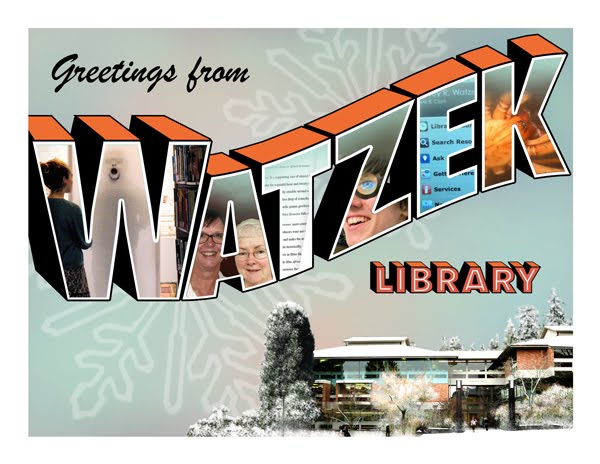
Watzek Library just sent out links to our first online Year in Review. This continues the tradition that we started last year of a more creative take on the library's annual report. To announce it, we sent out this post card:

Thanks to Anneliese Dehner and Elaine Hirsch for their great work on this project. Its a work that really reflects the greatness of the library and the college.

Monday, November 7, 2011

Presentation on Library Outreach

At the end of last week, Interim Associate Director of Watzek Elaine Hirsch and I gave a presentation at the Northwest Association of Private Colleges and Universities gathering of library directors. The topic was innovative marketing and outreach efforts at a liberal arts college library.


Overseas Study, Digitally Mediated

One of our newer approaches to digital projects follows a model something like this:
  • we work with a faculty member to conceive of an evidence-based assignment for a particular class
  • students in a class go out in the field gather evidence with cameras or through other means
  • they analyze the evidence
  • the library helps them organize the evidence and analysis and present it on the web
We first followed this model in last fall's New York City Graffiti Art Project. Then did another variation on it for a Perspectives in Biology course in which students gathered and classified spiders in the area. This fall, students studying abroad in India have been documenting their experiences using a kind of flickr mashup. It provides a venue for students on the program to photograph things, describe them, and classify them according to a particular schema. The schema is oriented around topics that the students must address for an assignment including modernization, environment, culture and religion. Our site aggregates all the entries for the entire group of students so that their work may be viewed as an integrated whole.

One of the benefits of this kind of project is that the student work becomes highly visible to other students and perhaps this incentivizes higher quality work. The documentation also has the potential to enrich the entire web.

We have a couple other biologists interested in doing more documentation and another overseas program in the works. One of the challenges ahead is to try to develop a more general purpose web site to support these kinds of activities.


Sunday, September 18, 2011

lessons from Clinton Street Video

Yesterday afternoon, I dropped our Netflix DVD service, mainly because we've stopped sending the discs back and forth. Now we use Netflix streaming and Amazon video via a Roku more and more frequently. But part of the decision was also an intention to get back to using our local video store, Clinton Street Video. Clinton Street is about six blocks away with a great selection of films and the expected indie-Portland vibe. Walking down there with the dog used to be a cherished ritual. When I drove by a shuttered Blockbuster on Powell & 39th a week or so ago, the urgency of helping keeping this place in business was apparent (though I'm sure that was a good short term burst for Clinton St.).

So last night, the wife, kid, dog and I headed down there with romantic notions of browsing the collection and being inspired by the presence of physical media (at least in my head). In the back of my mind was also a move that we're considering at the library: whether to put the media collection out in the stacks.

The walk down there was great. (Sometimes things get out of control with dog and kid, but things were unexpectedly peaceful.) When I got there however, I was reminded of all the reasons that on demand video is better. Clinton Street Video was its usual charming, hip self. But there the new release section was crowded and as the dog barked outside and a few whines came from the three year old, I pushed myself through the crowd and attempted to browse.

One of the first things I immediately missed was the inability to easily dig deeper when looking at a title--the information was limited to what showed up on the box, with no easy way to hop on the internet for reviews or a trailer. My Android was in my pocket so I had an impulse to pull it out but because of the time crunch, I resisted. Also, given the limited categories of materials in the store, I felt a lack of curation compared to Netflix's various recommendation services. Then there were the "checked out" labels on the boxes...this was always annoying, but now it just seemed completely unnecessary to have to wait for someone else to finish watching something so I could get to it.

Maybe if I'd had more time, I'd have experience things differently. I could have enjoyed a leisurely browsing of boxes on the shelves. I might have tapped the knowledge of the staff for recommendations. A serendipitous conversation might have ensued with a fellow customer about films

Some reinvention of the local video store will certainly be necessary for long term survival, as this article asserts. The broad trend is similar for libraries: spaces are now important for events and connection with people as much as housing material.

Eventually we made it out of there with a DVD for the kid. The wife and I ended up watching something on Netflix streaming and then later Amazon video.

Wednesday, September 7, 2011

envisioning

Someone recently asked me about my vision for the college library of the future. Here goes.

I would want a library that:
  • is service-oriented and rock-solid reliable. This never goes out of style.
  • is agile. The information environment is in constant flux, and an academic library needs to be flexible enough to quickly accommodate new trends in scholarly communication and research and communicate those trends to their local community.
  • provide spaces conducive to creativity, knowledge sharing, and contemplation. The library space should retain traditional elements associated with access to printed materials and quiet contemplation and also more collaborative spaces that facilitate the transfer of tacit knowledge between people.
  • raises expectations for research conducted by students. By working closely with students and faculty and by strategically developing collections and services, the library should enable really strong student research.
  • has character. The library should generally have a friendly and interesting vibe as evidenced by the general feeling in the space and the attitude of the staff.
  • is a strategic asset for the parent institution. Rather than simply being a generic set of resources and services on par with peer institutions, the library should help distinguish the institution from its peers though unique collections, opportunities for student research, excellent service, etc.
  • involves students in a pervasive sort of way. Students should take part in all the cool things that go on at the library as patrons, researchers, employees, practicum participants, etc.
  • acts as a laboratory. Even in the electronic age, the library should be a place where creativity, experimentation, and discovery takes place through encountering sources, using technology, or bringing together people to co-create.
  • has a creative, motivated, staff dedicated to the library and the broader institution.
Hopefully that about covers it.

Friday, September 2, 2011

incentivizing great student research

A recent piece in Inside Higher Ed reports on an ethnographic study that investigated college student attitudes and practices as they pursue information research projects. The results indicate that many students are far from prepared to do good college-level research. The comments on the article toss out a few ways of changing the state of things: information literacy programming, required library research classes, closer cooperation with faculty, etc.

One step that we at Watzek Library introduced this year takes the approach of highlighting strong student research through an undergraduate student research award in our first year Exploration and Discovery seminar course, which requires a research project in the spring term. The award is a celebration of what we're about at the library: great student research. But its also a subtle way of encouraging students and faculty to set high expectations for research, which should in turn help information literacy overall. Finally, it provides a great opportunity for students to practice up for more opportunities for academic honors and awards later in their undergraduate and possibly graduate careers.

Congrats to Sara Miller and Devin Owen, winners of the first-ever Watzek Student Research award!

Thursday, July 21, 2011

Alliance shared ILS: it's about shared culture not shared technology

At the recent Alliance Summer meeting, I gave a presentation with Natalie Beach on the work of the Shared ILS task force. It was great to see all the interest in this initiative and now that Council gave the go ahead to proceed with procurement, the rubber will really hit the road.

I think there may be some misperceptions about where the value will come from with this initiative, however. In the last couple decades, many institutions shared an ILS in order to save hardware and software licensing costs and system administration costs. This is certainly a factor, but I don't see this as the primer driver of sharing an ILS in the consortium. With software available in the cloud, libraries should be able to acquire a fairly robust, feature loaded ILS on an individual basis at a reasonable price.

I think the real value of the shared ILS will come from shared workflows that the system can enable and foster. A simple one is of course borrowing within the consortium. A new system should support this existing practice in a more efficient way than the current system. Collaborative technical services could be a new shared endeavor, but it will really be the culture and practices of collaboration not the technology that determines the success of this.

The Alliance is an organization that at least as a starting point, is based on geographical proximity. In an increasingly electronic environment, this proximity matters less and less for the sharing and provision of information. But the proximity and the organization itself can continue to foster a culture of collaboration and sharing and going into the future. This will be the Alliance's biggest asset. The Alliance should invest not only in infrastructure that enables collaboration but also in that shared culture. That is, creating a culture of working together. The Summer Meeting and the upcoming shared technical services symposium are ways that we can begin to create that culture.

A big question related to the ILS in general is how relevant it will be in an increasingly electronic environment. In the print environment, the library could legitimately make the case that the ILS functioned to manage its collections. But the reality of the electronic environment is that collections come in large aggregations that are often cataloged and organized by the content vendor. In the future, the function of "managing" electronic content for your library could be as simple as flipping on or off a few hundred different content products. ILS vendors are making their best efforts to position their products as managers of highly complex electronic content. But there is a question in my mind about how complex of an activity this needs to be. An interesting twist is that a content vendor, Proquest, will be offering an ILS product through Serials Solutions.

Monday, May 9, 2011

Digital Initiatives at the Liberal Arts College: One Year On

About a year ago, I wrote a piece on synthesize-specialize-mobilize about our efforts at Lewis & Clark to develop a digital initiatives program. Since then the number of projects in our portfolio has expanded significantly and I think we are building momentum towards a solid and sustainable program. We have a library-led project with a regional interest and appeal in our poetry program (Oregon Poetic Voices), a faculty driven NEH sponsored digital project (Rabat Geneziah), a couple student-oriented projects around spiders and graffiti, and a number of "consulting" style projects in which we've provided advice, expertise and assistance but that are really externally managed by faculty. Coincidentally, we just had a nice piece about our digital initiatives program come out in our alumni magazine.

"Digital initiatives" is a somewhat imprecise label for a variety of different activities and programs that academic libraries pursue in relation to digital collections and digital scholarship. I like to make a distinction between the service-oriented approach to digital initiatives and the project-oriented approach, though there is plenty of fuzzy area between the two. Some organizations focus on a set of fairly well defined services around particular types of digital objects. See, for example Oregon State University's Center for Digital Scholarship and Services, which offers support for digitization, electronic publishing in the journal and monograph forms, and institutional repository services. Other digital initiatives units are more oriented around projects with a less precise focus on specific services. Brown University's Center for Digital Scholarship falls into this category, with a focus on providing support for thematic digital projects.

As I indicated in the post a year ago, I believe that the project oriented approach is the more fertile area for a few different reasons. First, some of these more transactionally oriented digital services such as digitization or scholarly repository provision may be more effectively handled by organizations that transcend the single college or university. Digitization can be outsourced and disciplinary scholarly repositories are often more effective than institutional ones (think of arXiv). Digital projects offer the opportunity to engage in a live scholarly project that may be focused on teaching, research or both. Furthermore, projects can offer the opportunity to leverage local expertise to move them forward: existing working relationships with faculty, connections to students who may contribute to the project, ties to a local technology infrastructure.

Perhaps the most compelling reason to focus on thematic digital projects is that there is more passion around them. We have an archive of electronic student theses that we've been diligently working to populate over the years. It is a useful, worthwhile project, one that students and faculty appreciate and we've got big ambitions to expand it to include multimedia. It's built much like our library collection through acquisition of items across subject areas. But there is limited passion around this project because it is simultaneously about everything and nothing.

If I look at our digital projects, however, every one of them is been borne of creative or intellectual passion, and often project usage stats on Google Analytics demonstrate that this passion is contagious. Doug Erickson, the founder Oregon Poetic Voices, has been traveling around Oregon to capture poetry readings in all sorts of obscure places and build out this archive. He lives and breathes this project. This applies absolutely to the other projects leaders as well: Ted Vogel and accessCeramics, Oren Kosansky and the Rabat Geneziah, Greta Binford and Spiders, Margo Ballantyne and Graffiti, Paul Merchant and the William Stafford Archives.

These types of projects demonstrate how scholarship intersects with sophisticated ways of organizing, presenting and analyzing information. Academic libraries, for the most part, rely on content vendors like JSTOR to construct libraries of the kinds of published material they used to organize on their shelves. We need to spend less and less time building our own library and instead shift our focus towards creating specialized digital libraries that advance teaching and research. This role is increasingly being labeled support for digital scholarship. For example, Brown recently renamed their Center for Digital Initiatives the Center for Digital Scholarship and Rice did the same. Recent large foundation grants to liberal arts colleges such as Mellon's grants to Hamilton, Occidental and the Five Colleges of Ohio focus on digital scholarship and digital humanities and retooling the library to support such endeavors.

Last winter we worked with our Sponsored Research Office to host a faculty workshop on digital scholarship. Digital scholarship and digital humanities are big buzzwords these days and we sought to capture some of that momentum. Despite the lure of THATCamps and great NYT's pieces on "Humanities 2.0" I do worry that some faculty might get scared away by these terms. At some schools, there are faculty who self identify as digital humanists but I don't think we have any like that here. In our case, the most promising approach has been to tap into their scholarly interests and passions and demonstrate what new possibilities that the digital can open up.

It remains to be seen how much our digital initiatives program can grow. As we recruit faculty to join the fold, I would say there is a spectrum of interest levels. Some scholars have a fleshed out idea about where they would like to go, and they are ready to put time and energy into the project to get it going. They may or may not need our help and resources. Other faculty have ideas, but they are more loosely formed, distant aspirations. Completion of tenure files and other more pressing priorities stand in the way. Other scholars may not have any specific ideas, but they are observing a flurry of activities in their own disciplines around digital resources and have an interest in keeping aware of what's going on. Ideas of their own may be germinating.

How do we move those that aren't quite ready to begin projects towards that stage? How do we bring faculty without an interest into the fold? Grants provide a strong incentive: the financial resources and the prestige attached can be a compelling motivator. Most of our projects have some degree of external funding. Finding opportunities to demonstrate the possibilities out there to faculty, including the grants and projects colleagues have been successful with can also help. Our workshop was an opportunity to do this. Above all, finding a way to demonstrate that a particular project can really advance a particular interest or passion is the best motivator.

And what about the perils of success? How do we handle it when we demand for digital scholarly support outstrips our ability to supply that support from our office. We have not developed a formal system for prioritizing projects yet but one could be envisioned that would take into consideration factors such as time commitment, research impact, scholarly impact, cost, etc. Most of our projects have as of now focused on creating a collection that in an of itself serves as a learning and/or research resource. The most compelling projects in a liberal arts setting, however are those that engage students in their creation.

As we seek outside funding for projects, we need to consider ways to provide elastic support mechanisms when large waves of projects, ideally with some level of external support, come our way. Perhaps this means developing relationships with some outside contractors, who can step in to provide expertise when needed. We have some experience with external web development expertise, and we've brought in external help in visual resources.

A bigger question relates to the expertise that makes sense to source locally versus externally. In redefining library services and expertise in our current environment, it is always worth pushing on this question. Project initiation and management done locally can help get projects off the ground with a low barrier to entry. Local project managers can tap into trusted networks of people and resources to move a project forward and sustain it in a stable fashion. They can organize a fundraising strategy that makes sense for the local environment, and orient the project in a way that elevates the institution. Design and technology done locally can tap into existing infrastructure that may get the project off the ground faster and allow it to be maintained over the long term. Projects can be a vehicle for bridging interdisciplinary boundaries at or even between institutions.

At the same time, there are real possibilities for more external models of support and I think the trend is in this direction. There is the cloud-based DIY approach. We've sent a few faculty to Omeka.net to run with projects on there own and this is working pretty well. There is the external contractor approach. Sometimes I wonder if giving faculty easy access to very specialized expertise on demand, say a GIS specialist or a web developer would be a good way to catalyze innovative projects. Also, tapping into digital projects done at other institutions seems like a natural approach for some projects, Furman University's participation in the Homer Multitext project being a nice example of this.

What would define success for a digital initiatives program at a small liberal arts college? Perhaps, if we advance scholarship and or teaching for 5% of the College's faculty and 10% of our students in a given year, that would achieve a significant and relatively broad impact on students as well as advancing faculty research and creative agendas. Should those numbers be higher or lower? In theory, the experiences that the projects offer to students and faculty could have a spillover effect into other scholarly endeavors with which we are not directly affiliated. Digital initiatives fit in with the larger portfolio of academic support we provide including traditional reference and instruction, collection development, and work with special collections so they might also be seen and justified as a part of this larger package.

From this interim director post, one of the things I strive to articulate is the entire spectrum of research and teaching support we provide, from assisting students with basic research questions, to designing assignments with faculty, to building innovative digital projects, to putting students in touch with unique archival documents. It's a humbling and exciting adventure and I will continue to provide updates on this blog.


Friday, April 29, 2011

thoughts on e-books and the ILS

I've been quieter about library systems and technology on this blog than on synthesize-specialize-mobilize, but I'm going to return to that realm for this post. I've had the privilege of joining the Orbis Cascade Alliance's Shared Integrated Library System Team this past month. This team is charged with analyzing the market for a shared ILS for the Alliance and investigating options for its procurement. The team read over RFI responses submitted by several vendors the other week giving us a general picture of the maturity of the market.

I'm not going to comment on those RFIs--we've promised to keep them within the Alliance. But I will say that this process and our library's recent exploration of the e book marketplace has got me thinking about where the next generation of library management systems should go.

I've been a champion of the WorldCat-based ILS for a long time now. Putting the world's largest cooperatively created catalog at the center of a library management system is a logical way to leverage network effects. It also could enable libraries to see data about their activities in the aggregate. OCLC clearly has a strategic advantage with WorldCat data as well as their resource sharing network. One of the main drivers of the Alliance effort is greater collaboration on traditional technical services activities like acquisition and cataloging of print materials and the shared WorldCat database might enable some deep collaboration here.

But if we really are moving into a world where e content becomes prevalent, or even dominant, the central nature of WorldCat bibliographic data is up in the air. When you have a scenario where libraries purchase large packages of electronic books, it doesn't necessarily make sense to do the cataloging for these in the distributed sort of way that WorldCat is built around where libraries do original cataloging as they get items in hand. It makes more sense to perform that activity at a higher level on the chain: the publisher, the book vendor, a national library. Likewise, if we load thousands of records for e books into our discovery system for demand driven purchasing, the records need to be created ahead of time in the absence of physical items.

Furthermore, the expectation for full text searching of books is growing, something the WorldCat database can't help with at this point. Fundamentally, WorldCat is based on records whose data was intended for cards in a print catalog. In a search engine world, an ILS built around managing a catalog, even a web-scale next generation one, may not make as much sense as it used to.

The ability to easily assimilate and manage large pools of vendor supplied data and metadata for licensed and purchased e content may be the most essential aspect of the next generation integrated library system. Serials Solutions seems to shine in this area historically with its e journal products and more currently with Summon while I've been less impressed with OCLC's record here.

It also seems logical to include digital collections management as a next generation activity of the ILS, though its also possible that the tools for this activity (DSpace, ContentDM, Omeka, Shared Shelf, etc.) are evolving too independently from the ILS market to try and bundle them in.

On another note, our library looked at purchasing some e book packages recently. Before looking closely, I had the impression that it was possible to license large aggregations of high quality e books. But what we're finding is that many e books are only available for sale, and at very little discount from the print even if purchased in aggregate packages. This situation really makes the demand driven acquisitions model seem attractive, though I'm leery of buying e books on one platform should that platform prove to be funky or worse, extinct, in the future.

Ebrary's 'Academic Complete' package seems to be a good deal. Offered for a modest annual fee, it provides access to some 50K e books. I get the impression its sort of like the NetFlix Instant library: it offers a wide array of quality content, but is by no means comprehensive and many of publishers' newer, popular titles are not included.